Past Sale Invitations 2002-2005
From our 2005 Christmas Sale Invitation: Mishka
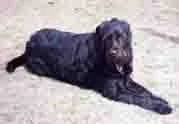
When we moved to the country in 1995, one of the nicest additions to our family was our dog Mishka. She became our friend and "Greeter". She was here for every Sale and was a good dog. When she was young she used to chase the deer and coyotes; we remember her as a black speck chasing a bounding deer. We were always afraid that she would catch the deer or that the coyotes would catch her. She wasn't a good dog at first. She was rude and sometimes aggressive; she could be snappish when people touched her food and when greeting people she would sniff in embarrassing places. But she was fun from the start, in a maddening sort of way, and we loved her. She failed her first obedience class and, worse, she chased cows, which in this part of the country, can mean a death sentence. But she lived, and became a black and beautiful part of our landscape. Wherever we walked, she was with us, always in front of us when she was young, but lately more often behind us. She was a very good dog. Her job was to watch, to bark, and to never, never bite. Always a part of our Sales, she will be missed this year. When she was young she would sometimes take a child's cookie, but as she grew older she learned not to do this.
It's been several years now since she'd chased any deer. She had grown from her youth, to middle age, to aged so quickly. She died on November 8th and we miss her. There is a black hole in our landscape, the ghost of a good dog.
From our 2005 Spring Sale Invitation: Yunomi
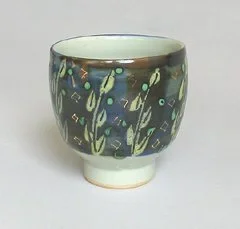
Yunomis are Japanese teacups and, like our teacups and mugs, are made in many sizes, from the size of sake cups to the larger sushi shop size, which is the size that I make. I've often been asked about these cups, sometimes because of the price (they cost more), and because of the spelling of the word.
Drinking cups are probably the most 'intimate' pots that we make. They are the only pots, in western culture at least, that we put to our lips. (There are exceptions of course: soup cups, coffee bowls in France and soup bowls in the Orient). Yunomis are more tactile than most cups. Mugs have handles and are fast. Yunomis don't have handles, so they need to be handled with more care. They take more time to make and decorate and they take more time to use: yunomis are slow pots in more than one way.
I think that this intimate connections we have with cups contributes to the love some of us have for pottery. Nursing a warm cup, combined with an addiction to tea or coffee is a potent sensory experience. I love Java, but especially in my favourite cup!
From our 2004 Christmas Sale Invitation: Miscellany
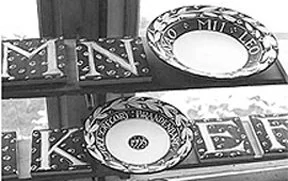
Commemorative plates and bowls have been made (probably) since there were literate potters. There are many examples of poetry and religious quotations on Persian pottery from the 10th century. Wedding plates and betrothal plates were made in England and Europe since the 16th century.
The first commemorative pots that I made were at Wenford Bridge Pottery in Cornwall in 1978 for the 25th anniversary of the Coronation of Queen Elizabeth II. I made dozens of mugs and some beer steins that had EII R, a crown and the dates 1953 and 1978 scratched into the slip. Since then I have made thousands of commemorative mugs, albarellos, wedding plates, birth plates and bowls. I have made letter and number tiles and trivets as well (I'd love to do a complete tile alphabet for someone's nursery). The most difficult and memorable commemorative plate that I have made was for Beryl Hedley-Smith's 80th birthday, which included her name and the names of her seven children.
In 1975, in Jean and Henry Ward's collection, I saw my first harvest jug, inscribed with the following poem:
Ode to the Farmer
May the wealthy and Great, live in Splendour and State
I envy them not I declare it!
I eat my own Ham, my Chickens and Lamb,
I shear my own fleece and I wear it,
I have lawns, I have bow'rs
I have trees, I have flow'rs
The lark is my morning Alarmer,
So Jolly Boys now, here's God Speed the Plough,
Long Life and Good Health to the Farmer.
From our 2003 Christmas Sale Invitation: Slipware
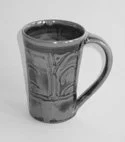
One of the glaze/decoration combinations that Sam has used for over 26 years is shown in the photo above (we call the pattern on this mug "eyebrow"). Potters sometimes mistake this technique for an iron glaze called tenmoku. Actually, it is a combination of an iron slip under a translucent glaze. Leather hard pots are dipped into the slip (a mixture of iron oxide and liquid clay) and then decorated by combing, while it is still liquid or soft. This method of decoration is called slipware. The technique was first used in China (like most things in ceramic history) and can be seen on pots made earlier that the 10th century. Michael Cardew (with whom Sam apprenticed in 1977) made slipped earthenware pottery at Winchcombe, and later used the technique on stoneware at Wenford Bridge Pottery. Sam learned to decorate with this technique at Wenford Bridge and has been using it ever since.
It is interesting to note, in case anyone collects old English slipware, that those early jugs and pots were glazed with a raw lead glaze, and should not be used. All of our stoneware pottery is fired to 2300 degrees F. (1280 degrees C.) and lead is never used at these temperatures.
From our 2003 Spring Sale Invitation: Copper Red
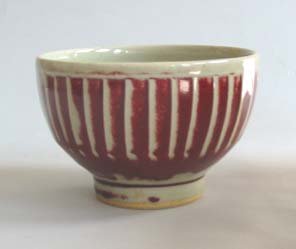
The colour photo of the fluted bowl has a glaze known as copper red or sang-de-boeuf. This glaze is another famous Chinese invention and is one that, until recently, I hadn't really liked. It can be too showy, so bright that it looks like paint. Although copper is a potent colouring oxide (there is only 1/4 percent in our red), the colour can be difficult to achieve, tempermental and fugitive. The atmosphere in the kiln, the speed of cooling, and the thickness of the glaze are all factors affecting it. When this glaze is imperfectly fired, you can find the full range of colour, from the pale green of the base glaze to red or plum. I find this contrast, although considered a defect by some, much more attractive.
From our 2002 Christmas Sale Invitation: Celadon
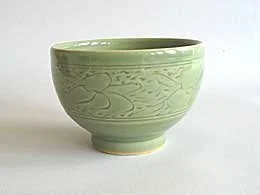
The bowl in the photo has a green glaze known as celadon. Celadon glazes, which range in colour from pale blue-green to dark olive green, are probably the oldest feldspathic glazes. The green colour comes from iron oxide suspended in the glaze melt. In early glazes this probably came from the stone or ash that was used to make the glaze. One of our celadons, made from the same granite tha we used for part of our stairs, developed a very nice pale green without any additional iron. According to Hetherington in Chinese Ceramic Glazes, the word celadon "derived from Saladin, Sultan of Egypt, who sent forty pieces of the ware to Nur-ed-din, Sultan of Damascus in 1171. Another derivation is from the shepherd Celadon, a character in a seventeenth-century romance called L'Astree, written by Honore d'Urfe. The shepherd was garbed in a grey-green coat of a distinctive tone"
Although today the celadon is not our most popular glaze, it has always been a favourite among potters, and at least one special friend.