Past Sale Invitations 2006-2010
From our 2010 Christmas Sale Invitation
This October I received the Linda Stanier & Family Memorial Award for 2010. This award was presented in Calgary along with the Award of Honour, presented to Katrina Chaytor and the Award of Achievement, received by Mindy Andrews. You can find out more about the awards and the recipients at www.albertacraft.ab.ca.
This is Linda Stanier's letter of nomination:
I first became aware of Sam Uhlick while studying Clay at the Nova Scotia College of Art and Design in the early 90's. Walter Ostrom, head of the ceramics program, declared one day that Sam Uhlick was the best potter in Canada. Specifically I recall that Walter felt Sam met the daily task of making a living as a studio potter with superb craftmanship and integrity of vision.
I was eager to experience Sam's work after that and quickly acquired my own piece of his after moving to Alberta a few years later. As an aspiring studio potter, Uhlick's work was an inspiration to me through its diversity of form, clarity of execution and diligent abundance. One often learns through example and with Uhlick this is particularly neceswsary as he is a shy and retiring figure, leaving the limelight to academics and showmen. But step into any major pottery venue in the last 20 years across Canada and there was work of Uhlick's to see, fondle and purchase. Oriental inspirations are evident in the simple cobalt/chrome colour combinations he uses. His sense of patterning is enlivened by the spontaneity of freehand brushstrokes and sgraffito. There is energy in his mark making. Energy of that kind is found in work that has been done many times and is the ultimate challenge for the studio potter: to present cliche's so clearly they appear original.
He has had the respect and attention of the Canadian ceramics community and is collected across our country and around the world. No mean feat for a potter working from Ardrossan, Alberta. It was, however, the quote included in the Clay 2010 catalogue that caused me to leap from my chair and fire him an email of acclaim, "If all ceramics were divided into two groups, there would be those objects that are dusted and those pots that are washed. Almost all of mine would end up in the kitchen sink." Such humility in the face of our celebrity age is truly laudable and evidence of an understanding of the true worth of hand made pottery: that it will live on as a testament to a moment of creative energy separate from ego through the continued celebration of daily use.
Sam Uhlick is a professional craftsman of tremendous creative and personal integrity and I feel it is this above all that qualifies him for this award in the name of Linda Stanier.
by Diane Sullivan
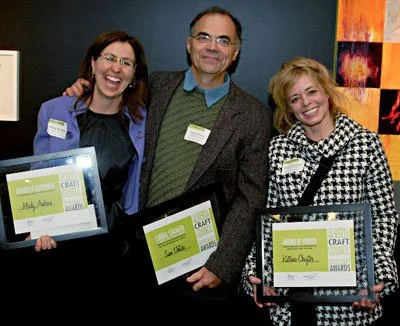
Photographer: Mike Lipset
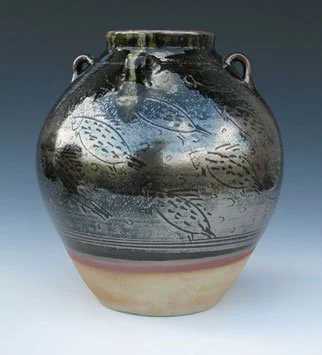
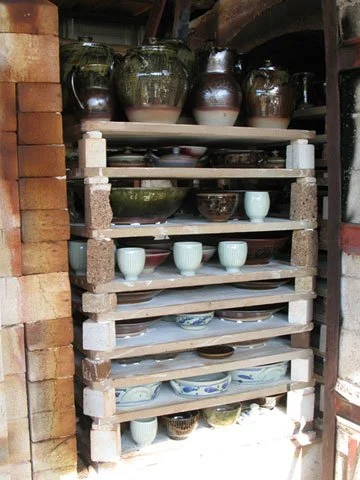
From our 2010 Spring Sale Invitation: Pottery Vibrations
Someone, about thirty years ago (I think in Ceramics Monthly magazine), compared the throwing marks on an ancient platter and the grooves on a record. (Younger readers should look up record/record player in Wikipedia). The idea they had was: wouldn't it be interesting if some future scientist could translate those throwing marks into sounds from the ancient potter's workshop? The earliest possible sound recordings! Thirty years ago this was an amusing and whimsical notion. These days perhaps it isn't so impossible. We hear about the ability of science to measure isotopes in a migratory bird's feather that will show where that bird had moulted. This seems amazing to me, so perhaps the possibility that potters might be inadvertently making sound recordings is not so laughable. Considering how quickly a pot may be thrown though, one couldn't expect to hear much more than fragments of a CBC radio program, or a dog's bark, from one of my pots. Possible sound recordings aside, I think that we potters do transmit vibrations to our work (for better or worse), with every touch of a finger or stroke of a brush. These vibrations may be too subtle for our modern scientific instruments to detect, but people who are sensitive to handmade objects can feel them none-the-less.
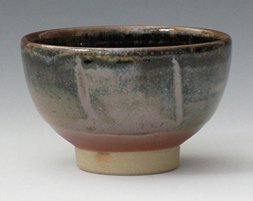
From our 2009 Christmas Sale Invitation: Cups and Saucers: "Many a slip..."
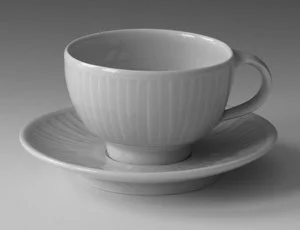
It has always been music to our ears when someone tells us they enjoy using our pottery. Functional pottery is tactile and needs to be used to be fully appreciated. But handmade pottery is relatively expensive; some shapes more expensive than others, and not always for obvious reasons. An example of this would be teacups and saucers, more appropriately called cups and saucers. Breakfast cups and saucers are used for coffee these days, or a comforting bowl of chicken soup. Saucer'd cups have been made for a thousand years; some beautiful examples from Chinese and Korean history are wine and tea cups with saucers. The western world didn't just get tea from China; we got "china" from China (now of course we get everything from China). A couple of hundred years ago, English teacups and saucers were just for the upper class. My own mother, working class and old fashioned (she was born in 1908), would have afternoon tea parties with her best bone china teacups and saucers. For most of us, slopping a dribble of tea isn't a problem, but if one is dressed up for afternoon tea, one can see the usefulness of a saucer. But why are they so danged expensive? In fact, we try to keep the price lower than it might be, just so we can sell them. Both the cup and saucer take more time to make than an ordinary mug. In addition, they are fraught with difficulty. The foot of the cup has to fit into the indentation of the saucer. The both have to come out of the kiln in good shape too. If just one of them is a "second" the set becomes a "second" or worse. There definitely is, for a potter at least, many a slip twixt the cup and the lip.
From our 2009 Spring Sale Invitation: Pottery and Food
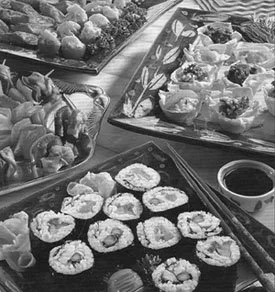
Recently on THE AGE OF PERSUASION (a really good CBC radio program about, of all things, advertising), Terry O'Reilly was told by a client that "we don't sell 3/4 inch drill bits, we sell 3/4 inch holes". You could say the same thing about purely functional commercial pottery; that it is the space which it contains that is important. I suppose as functional potters, we are, in fact, selling a better, we hope much better, "hole". Our pottery is meant to be used; the tactile appreciation of it is only possible when it us used.
Pottery and food have been connected for over 6,000 years of human history. A bowl is a symbol for food and life itself. Maybe because of this, pottery has been anthropomorphized; we talk about feet, bellies and lips of pottery, and although pots can last 10,000 years, they are fragile.
Commercial pottery is inexpensive and these days it might be hard for some to justify the cost of handmade products. And yet...there is, or can be, an emotional response to our pottery. We feel regret and even sadness when a really special pot breaks. Other people do too. Handmade pottery has warmth adn vibration that isn't present in commercial pottery; even the most skillfully made handmade pots have imperfections that show the process of making. There is an inherent depth to hand applied glaze, and a lustre in glaze and decoration that enhances food. We have heard from many people that "food tastes better in one of your pots". Not just pottery, but other handmade items, have this warmth and their daily use enhances our lives.
From our 2008 Christmas Sale Invitation:
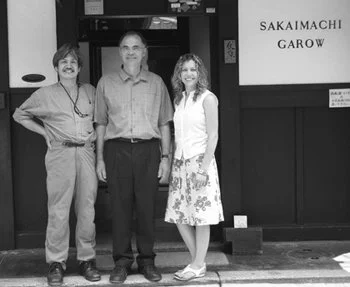
This has been an interesting and, at times, difficult year. I had my 55th birthday and up until this year I would have said that I have been aging gracefully; the wrinkles on my face were nicely catching up with the worry lines on my forehead. I'm afraid tht trend has faltered a bit in 2008. The shows at the Alberta Craft Council and in Kyoto were for the most part fun. As I said in my "speech" at the opening of the ACC show, "This show is a stage in this potter's life, and it's given me a chance to think about what I know and where I am". I have been comfortable with my pots and slow progress over the years, but I was grateful for this chance and I didn't want to disappoint my friends. I tried some new ideas with very mixed success; no one wants a chimney pot, but they were fun to make. They were also too heavy to take to Kyoto where they would have been even more baffling for the Japanese. The show at the Sakaimachi Gallery was a success and the trip to Japan with our daughter, Claire, was wonderful. Claire is an artist (www.clairelouiseuhlick.com) and is interested in architecture and art history as well. She was a lot of help in setting up the show and a pleasure to travel with. We stayed with my old friend, Mayao Umesao, who is a potter, and his wife, near Kyoto, for part of our trip. Mayao was the first person I met the summer of 1971, when I attended the Banff School of Fine Arts. It has been about 10 years since we last met si it was especially heartening to see him and his family again.
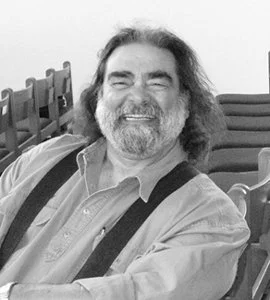
There were some losses in this past year too. The photo at the bottom of this section is of my friend Geoff Hughes. You might have seen him and talked to him at our sales over the years. You can read my eulogy for him at www.uhlickpottery.com/remembering-geoff. He is sadly missed by me and many more friends.
Finally, I should say that I have never felt more the blessings of my wife, Antonia, my family and friends (old and new) than I have this year.
Best wishes,
Sam Uhlick
From our 2008 Spring Sale Invitation: Sampler Poem Plate
I read this lovely poem in January and used it for not only this plate, but also for the title of the show "Alberta is My Home". I think you will agree that, in the case of this commemorative plate, it would be much more poignant if I were already dead, but all potters and artists hope that their work does "stand the test of time".
Samplers were examples of cross-stitching or embroidery done by young women during the 18th and early 19th centuries.
Elisabeth Crandall is my name
And America is my nation
Providence is my home
And Christ is my salvation.
When I am dead and in my grave
And all my bones are rotten,
If this you see
Remember me
When I am quite forgotten.
1845
From Wobegon Boy by Garrison Keeler.

From our 2007 Christmas Sale Invitation:
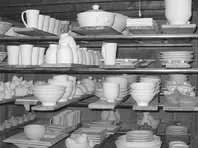
For all of our pottery friends and customers who haven't visited our workshop between sales, it is hard to describe the apparent disorder that you's see. Pottery in stacks, higher stacks if they have been bisque fired, smaller stacks if they are drying or waiting to be bisqued, along with pots on boards in the damp room waiting to be trimmed or handled. As well, there are the other projects that seem to happen simultaneously - repairing or making tools, woodworking or welding. this is our normal workshop and we seem to get a surprising amount of work done. Not, though, in a very scientific or business-like way. Someone came out to the workshop when we were in full production mode and exclaimed "What happened?!" Even the UPS driver once looked at the 'mess' and commented that it was a work in progress. In spite of this, we welcome visitors between sale.
I always use the summer months for mixing the clay, building equipment and working on the workshop/house itself, which is still not finished. This summer I prepared a new blunger for clay mixing to replace the old one (which is just about worn out) and finished two sides of our kiln shed. The stages of a cycle of pot making starts with mixing the clay (we've bought 137 tons of raw clay in the last 29 years), pugging (this is done in a pugmill, a machine that I built 25 years ago for mixing and de-airing plastic clay) and throwing clay, trimming and handling pots, fettling and bisque firing, glazing and decorating, firing and fettling the pots again, cleaning up and preparing for a sale. Easy to list the steps, but each step takes time and skill to complete. It's almost always been fun, though, for all of these years. There is a little bit of magic along with the art and science in making a piece of pottery.
From our 2006 Christmas Sale Invitation: Kiln Shed
When we first moved to the country, at the end of the summer of 1995, we moved to a house and workshop that weren't finished. There was painting, setting up the workshop, and a hundred other things to do. We didn't start to build the kiln until October. But we worked like mad and managed to make enough pottery for two firings in our new kiln. The firings were okay and we had some umexpected blue pots that were much admired by some, but never repeated. The doors weren't even hung in our house when we had our first sale that December. I remember that the weather was cold during the sale, but lots of people came and it was very heart-warming for us.
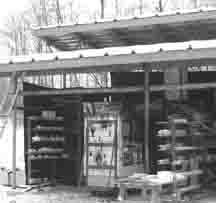
Although a kiln shed was in the plans, there were always more important projects (doors, bathrooms, stairs). This year we do have a kiln shed. Started in September, the last roofing was put on the day before it snowed. The trusses came from a demolition company, the standing seam roofing from our friend, Paul Ryan (Ryan Scrap and Industries) and the posts were piping from the inside of the oil field shacks that we got from O'Hanlon Paving. Along with 30 lbs. of welding rod, these materials were recycled to become our new kiln shed.
There is a business philosophy that says that companies should stick to their core product for greatest efficiency. Yet it has always been a pleasure for me to build the equipment for our workshop; to work with stone and wood and steel, as well as make the pottery, clay and glazes. A good business philosophy isn't alwasy a good philosophy for life.
From our 2006 Spring Sale Invitation: Time Flies...
An old joke that we tell in our family is the one that goes: Time flies like an arrow; fruit flies like a banana. We all know that the older we get the faster the arrow flies and we seem to be feeling it, especially this spring (of course fruit flies prefer an older banana). Some of you will remember the Christmas Sale at our old workshop in Bonnie Doon, when Anna was a new baby, mostly sleeping in her basket while we packed pottery. Over the past 25 years, Antonia and I have gone from having no children (that period didn't last very long!) to four children too small to help. Now we are blessed with four adults who are so helpful that it would be hard to do without them. We only have two living at home now, although they will all be helping at this sale.
Nicole, our youngest, is graduating from grade 12 this spring and will be leaving us for a Canada World Youth exchange in September. CWY is an exchange program whose mission is "to increase the ability of people, and especially youth, to participate actively in the development of just, harmonious and sustainable societies". The participants from both countries will be involved in community work projects, learn a new language and become better citizens of the world. You can find out more at www.cwy-jcm.org. You might remember that Anna was on a CWY exchange three years ago. If any of you are interested in this program, please talk to Nicole or Anna. One of the participants' responsibilities prior to leaving on the exchange is to do some fundraising. I'm sure that Nicole would welcome any donation to Canada World Youth.